Saturday, January 24, 2009

Male Beanie Knit Pattern

Lifecycle dragon


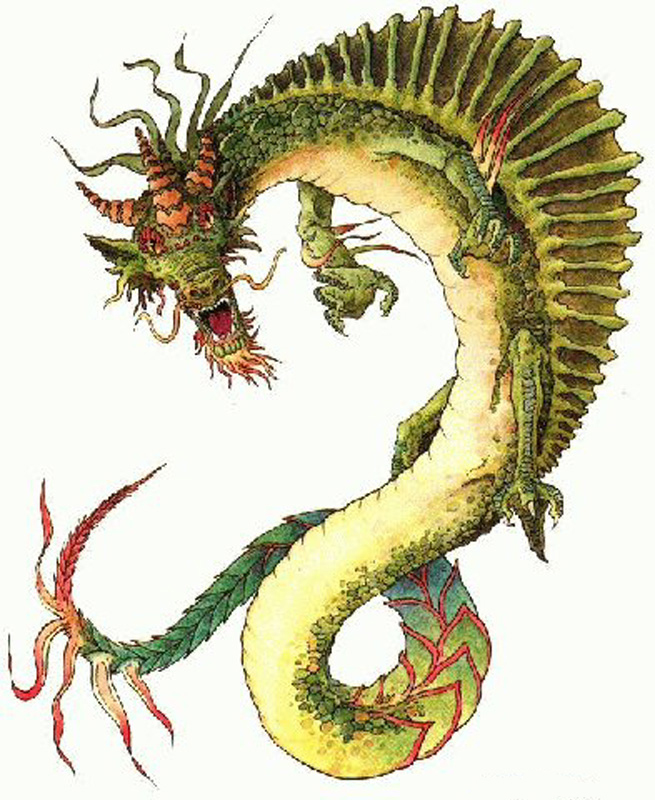
dragons lay their eggs on the eastern banks of mountain streams, rivers or lakes, usually need a thousand years because it opens up an egg and the event is always accompanied by a storm. When the first crack appears in an egg, both parents burst into loud cries the cry of the father stirs the winds, while the mother calms them. So here, once again, the balance of yin and yang. But when the egg hatches and the baby is completely born, storms shake the ground. Even the full maturation of a dragon is a long quest ion, which requires more than three thousand years, through several stages: first the child has the appearance of a water snake, then in fifty years develops a head of carp, making a Kiao. During the thousand years that followed became more and more like a fish: it is now as big as a carp, but his appearance is that of a dragon has four little legs, a long tail ', the beard and four claws each leg, but has the ear is deaf and is called Kiao Leng. In another five years developing the horns, which are used to perform a function that is due
hearing, and called Kioh Lung, the dragon most common. After another thousand years they will reach the wings and the creature called Lung Ying. According to legends, the female usually gives the light dragon nine children (number mystical importance to the East) nested, each with specific characters and personalities, which ispiranole different representations. There is no agreement on their names, but according to most of the testimonials on the cornices of the palaces are the bold, adventurous Hsien Hao, who loves to climb; often you see a picture of a dragon on the cover pages of the times also because it says that these animals are always alert. Similarly, images of dragons are placed on the pinnacles, especially in the form of his brother Chi Wen, who delights to contemplate the distances. On the doors you find the dragon Jiao, tight-lipped as the valves of a mussel, and on the piers and arches of the bridges, although all the dragons worship water, it is more commonly Pa Hsia, who is an excellent swimmer. The Picture of Suan I, fond of smoke and fire, is on the legs of incense burners, where his brother Pi Hsi, sturdy pack animal, and decorate the baskets holding the bases of the monuments. On the handles of swords and knives is Ya Tzu, warlike and valiant warrior, while Pu Lao, a lover of the sounds and loud screamer when attacked, is represented on the bells, and music lover Chiu Niu on stringed musical instruments. Finally, we find figures of dragons on stone tablets and books, because they love literature and study, on the gates of prisons, because they intrigue the quarrels and troubles, and on the throne of Buddha, for their propensity to rest.

Text For Seasons Greetings

human children of the dragon: the emperors


Besides the usual litter, a dragon - male or female - can mate with a human being, when men are born to become king. The rulers of many Asian countries claim to have ancestors of dragons and a titles which had liked to be called "dragon face." Other kings were confined to elect the dragons and their protectors should be to China, with the figure of the "Imperial Dragon", the vision of the animal as a symbol of royal power. The children of pride and honor a state law established that only the emperor and his entourage could use the image of the dragon with five claws, usually yellow.
Since the Chinese dragon was made immeasurably wise and beneficent dispenser of heavenly rain, it could rise to ideal metaphor worthy of the emperor, whose divine mandate, as a mediator between heaven and earth, was to ensure the welfare of his subjects. The great power of the dragon could
be transmitted to people by the good government of the sovereign. The sighting of a dragon was very welcome thing for him, because it was the message from Heaven to the people, by which it should be noted that its ruling was doing a good job.
Many legends arose about the relationship between the emperors and dragons, so people began to think that the first had the ability to change themselves in seconds. Yet, despite this high esteem that comes to worship, is expressed here contraddizionidella an apparent culture of the Far East and even among the Asian dragons concealed assassins, moved to the massacre in the name of withering irreverent appropriation of their power. The blood, fat, brain, saliva, the teeth and horns of the dragon are regarded by the Chinese miracle drug, used to treat everything. This
"dracofagia" also occur in European law, from which 'it follows that eating the heart of a dragon gives consumers the ability to understand the birds, the language of the dragon makes it able to win any verbal dispute, and blood smear dragon protects the skin against fe rite, in general, it is the dragon's blood that are accorded broader powers and effective for the Chinese, the best remedies are seen as the bones, which, however, seem rather easy to find. Until 1927, in fact, entire villages Chinese simantenevano found during excavations and selling them. When a delegation American Museum of Natural History came to China to investigate these rumors, he found with great disappointment entire warehouse full of those who had their animalipreistorici fossils, scientists Americans bought in large quantities, by donating a portion of the museum in Beijing and reserving the other at the museum in New York. After that, the sale of "dragon bones" was banned, but continues on the black market. Even the saliva of dragons, floating on the surface of the sea, is ideal for engraving jade and gold and can be used to produce fine perfumes and incense. In addition, it is said that dragon meat is a delicacy, so that the emperor Huo is famous for having cook a dragon fell on his house during a storm.